

In Wisconsin, we enjoy kayaking our rivers, cooling off in our lakes, drinking on our boats, and bragging about our beautiful waters. Many residents know a great deal about their local lakes, rivers, and waterways — but how much do they know about the water under their feet?
Hydrogeologists at the Wisconsin Geological and Natural History Survey study this subsurface water, called groundwater, to support the 95 percent of Wisconsin communities who depend on it. According to Dr. Ken Bradbury, retired Wisconsin State Geologist, this unseen water is worth paying attention to. “Groundwater is probably the most important natural resource we have in our state,” he says.
If you want the scoop on what’s going on down below, here’s a simple look at how water moves underground in Wisconsin.
What does water do under the ground?
Groundwater starts as rain and snow. When precipitation lands, some stays at the surface and runs into streams and lakes, but a portion sinks into the soil before traveling deeper between grains of sand and sediment, as well as cracks in rock, and into pores — or the empty spaces between particles of soil, sediment, or rock.
These layers of sediment and rock are called saturated when the pores and fractures are completely filled with water. This underground area, where all the pores are filled with water, is called the saturated zone. The top of the saturated zone — where air-filled pores change to water-filled pores — is called the water table. To pump groundwater to the surface and eventually to our faucets, a well needs to cross the water table and reach into the saturated zone. Then, groundwater will flow pore by pore into the well.
As Bradbury explains, “People often mistake groundwater for being a cavernous, underground river, when it is actually fine individual molecules of water moving between grains of sediment and rock.”
How fast does groundwater flow?
Groundwater is always on the move, traveling slowly and quietly.
In most parts of Wisconsin, groundwater moves only a few feet each day through pore spaces. But in spots with cracked bedrock, called karst, water can move much faster. Karst landscapes form when carbonate bedrock slowly dissolves in water. Over time, this creates holes, cracks, sinkholes, and sometimes caves. Because water moves quickly through these openings, karst areas can have disappearing streams and fast-moving groundwater. In Door County, scientists have recorded water that traveled through underground cracks one mile into the rock in just one hour.
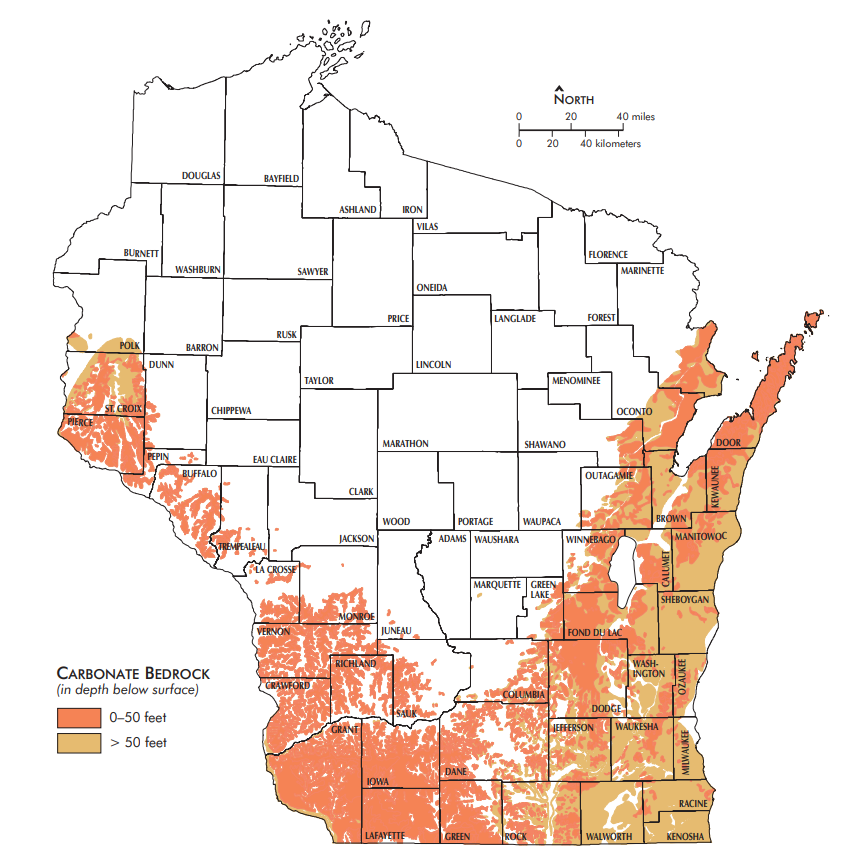
If you live in eastern Wisconsin, such as in Door, Kewaunee, Brown, Calumet, or Manitowoc counties, you may be standing on karst, a landscape formed when carbonate bedrock dissolves over time.
Karst creates the following:
- Sinkholes
- Underground channels
- Enlarged fractures
- Disappearing streams
- Rapid groundwater flow
Usually, groundwater moves less than a foot a day. But in karst, it can move more than 100 feet daily. That means anything on the surface can reach your well fast, sometimes changing water quality in just a few hours.
When surface water can quickly join the saturated zone, it increases the risk of surface pollution reaching the saturated zone that we use for drinking water. That means anything on the surface can reach your well fast, sometimes changing water quality in just a few hours.
Karst landscapes might look beautiful, but groundwater needs to be treated with care here, especially if you use a private well.
Because all water starts at the surface, what we do on the land, such as farming, using septic systems, or construction, can increase the risk of water quality issues underground. This is why hydrogeologists work hard to figure out where water comes from, where it’s going, and how fast it moves.
What does this mean for me?
We may not see groundwater the way we see our lakes and rivers, but we all rely on it. The rock layers holding this valuable resource shape the amount and quality of water, and these layers differ around the state. Talented hydrogeologists continue to study how groundwater moves, how it interacts with rock layers and soil, and the quality of our groundwater in Wisconsin.
If you’re in a karst region, keep a special eye on your well and septic system. Private well owners are tasked with managing their own well water and that can be challenging when it comes to knowing where to start, and what to test for. The Natural Resources Institute offers resources to help well owners manage their private well systems.
You can also explore the Wisconsin Geological and Natural History Survey’s catalog of groundwater resource publications and maps to learn more about groundwater in your area.
Paying attention to what’s happening underground, how water moves, where it comes from, and what affects it helps us protect the resources that make Wisconsin feel like home.