

By Felix Boeing, Rural Partnerships Institute; Steve Vavrus, Wisconsin State Climatology Office; Paul Block, UW-Madison Civil & Environmental Engineering
Current predictions for the 2025-2026 winter season suggest Wisconsin can expect a milder winter compared to the past. This finding is consistent with the historical trend of warming winters.
The analysis of Heating Degree Days (HDD) predictions by Dr. Paul Block, Professor in Civil and Environmental Engineering at UW-Madison, and graduate student Felix Boeing found that the state is expected to experience approximately 7% fewer heating degree days compared to historical norms.
HDDs are a method to measure how cold it is compared to a baseline. They are calculated by subtracting the day’s average outdoor temperature from a baseline of 65°F. For example, a 30° day would equate to 35 HDDs, and anything above 65°F would count as 0. By adding these HDDs over a specific time period, we can compare how cold that period is relative to historic norms. It’s a bit counterintuitive, but important to remember that more HDDs are associated with cold temperatures, because they indicate a greater number of degrees below 65°F (when heating is likely required).
This analysis uses long-term temperature data from the National Oceanic and Atmospheric Administration (NOAA), which divides Wisconsin into small grid cells and allows winter conditions to be examined consistently across the entire state back to the early 1950s. Heating degree days were calculated for December, January, and February, and past winters were compared with climate conditions observed in November to identify patterns linked to colder or milder seasons. In particular, ocean temperature patterns in the Caribbean and parts of the Pacific have historically influenced winter temperatures in Wisconsin. Those same November conditions were then used to estimate what the 2025–2026 winter is likely to bring, with results first calculated statewide and then applied locally to show how conditions may vary across the state compared to recent winter averages.
Figure 1 shows the predicted cumulative HDDs for the state across December, January, and February for the 2025-2026 winter season. The red color indicates that statewide HDDs are predicted to be lower than normal, associated with slightly milder temperatures. While the variation is limited, northwest Wisconsin’s darker red color indicates that the region is expected to experience an even milder winter, relative to typical northwest Wisconsin conditions.
Figure 1. Forecasted HDD for 2025-2026 Winter Season
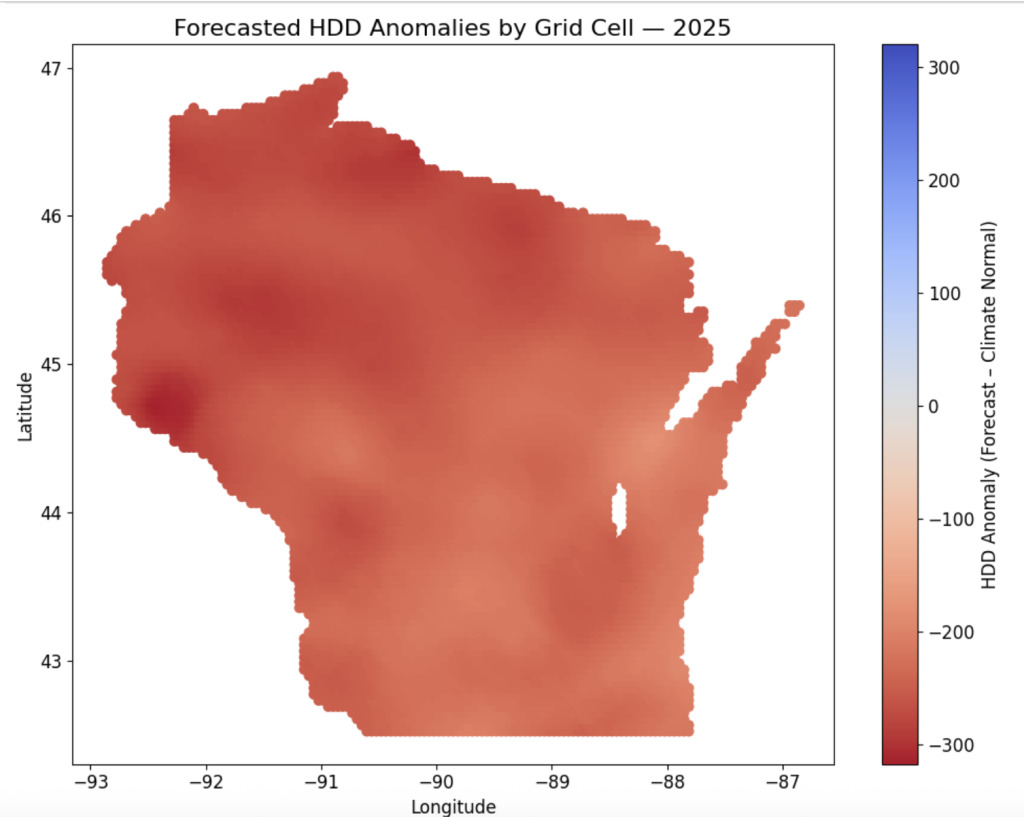
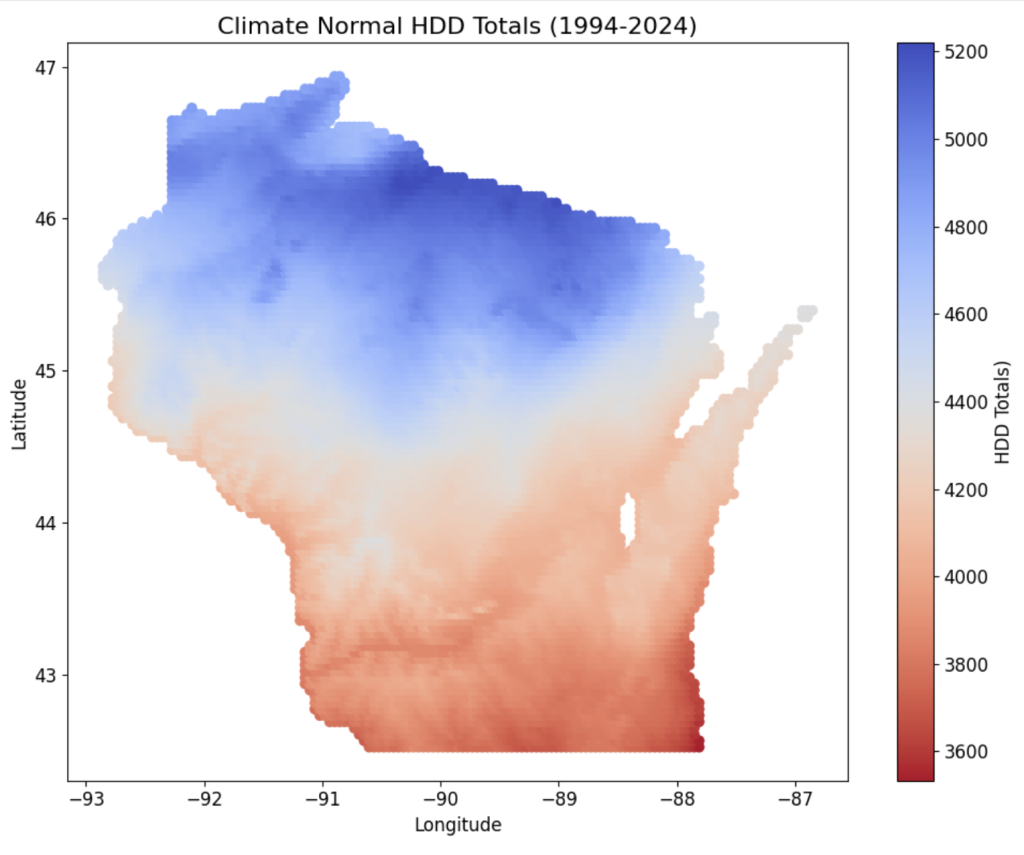
Figure 2 illustrates the historic norm of HDDs in Wisconsin since 1994. On average, there are typically around 4,000 total HDDs between December and February. In other words, if you added up all the HDDs for all the days in those three months, that would be your approximate result. As expected, northern Wisconsin has more HDDs on average, indicating colder temperatures compared to the southern part of the state. As a comparison, Miami, Florida has about 100 HDDs on average.
Figure 2. HDD Historic Normal
These findings do not mean that it is going to be a “warm” winter, or that there won’t be any snow. When forecasts suggest a slightly milder winter based on HDD, there can still be many sub-zero days hidden within the season. However, on average across December, January, and February, Wisconsin can expect slightly milder temperatures.
This finding is also consistent with the long-term trend in Wisconsin during winter, which is the season that has warmed the most since the middle 20th century. Climate models project a more pronounced winter warming trend in the future with accompanying declines in heating degree days.