

A new research tool developed through the Wisconsin Rural Partnerships Institute (RPI) is giving lake users and public health officials a season-ahead outlook on harmful algal bloom risk for Petenwell and Castle Rock Lakes.
The project, led by researchers Emma Blackford and Paul Block of the UW-Madison College of Engineering, in collaboration with county public health officials, uses a statistical model to predict summertime water quality conditions in the two central Wisconsin lakes months before the summer season begins. Researchers used the 2026 season to build and validate the model, with the tool expected to support public messaging in 2027.
How it works
The model draws on decades of satellite-derived chlorophyll data (via LAGOS-US and Landsat) to establish each lake’s historical seasonal pattern. Petenwell, researchers found, has a notably stable seasonal cycle, while Castle Rock’s is more variable year to year. From there, the team identified pre-season predictors that correlate strongly with summer chlorophyll levels, including May air temperature at the Necedah weather station and the strength of the May Pacific-North American (PNA) climate pattern, which influences regional weather through the East Asian jet stream. Combining these variables, the current model explains a strong share of the year-to-year variation in Petenwell’s July–September chlorophyll levels.
Rather than producing a raw chlorophyll number, the tool translates its forecast into three categories — Below Normal (better water quality), Normal (average water quality), and Above Normal (poor water quality) — reflecting the likelihood of each condition occurring that season.
The 2026 outlook
For Summer 2026, the model pointed to elevated risk, or a 51% chance of above-normal chlorophyll levels on Petenwell Lake between July and September, compared to a 38% chance of normal conditions and just an 11% chance of below-normal (better) water quality. When blue-green algae reach high levels under these conditions, they can produce toxins capable of causing illness in humans and pets.
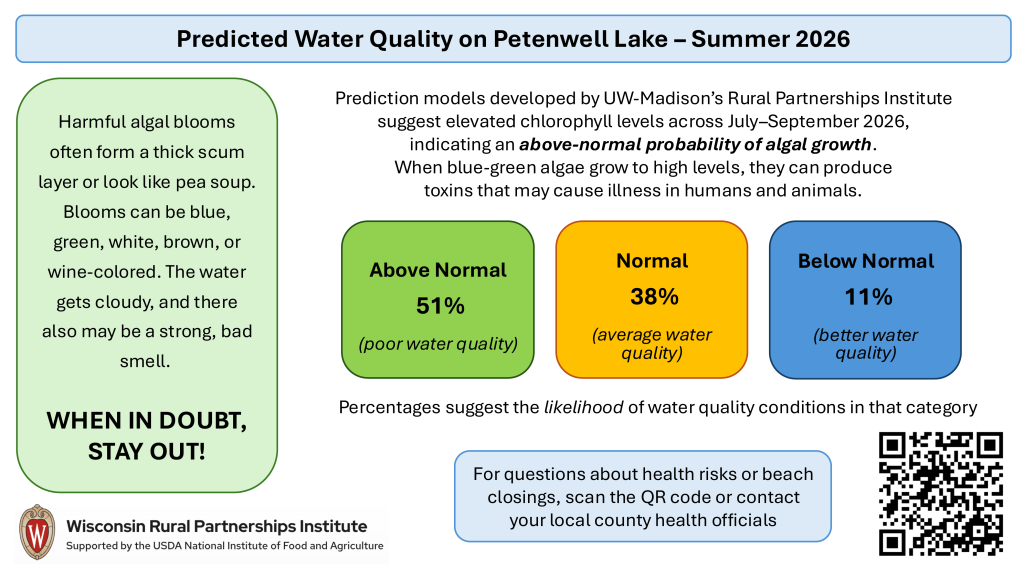
Lake users are reminded that harmful algal blooms often appear as a thick scum or “pea soup” layer, can range in color from blue-green to brown or wine-red, and may come with cloudy water and a strong odor.
Built on proven science
The Castle Rock and Petenwell tool builds on an established forecasting approach pioneered by the Water Systems & Society Research Group at UW-Madison, which has run a similar experimental cyanobacteria and beach-closing forecast for Lake Mendota, adapting that framework to the unique conditions of these two central Wisconsin reservoirs.
The research team’s next step is to refine the model further by incorporating additional in-lake and local/global climate variables to sharpen pre-season predictions in future years.
Residents and visitors with questions about health risks or beach closures are encouraged to contact their local county health officials.