

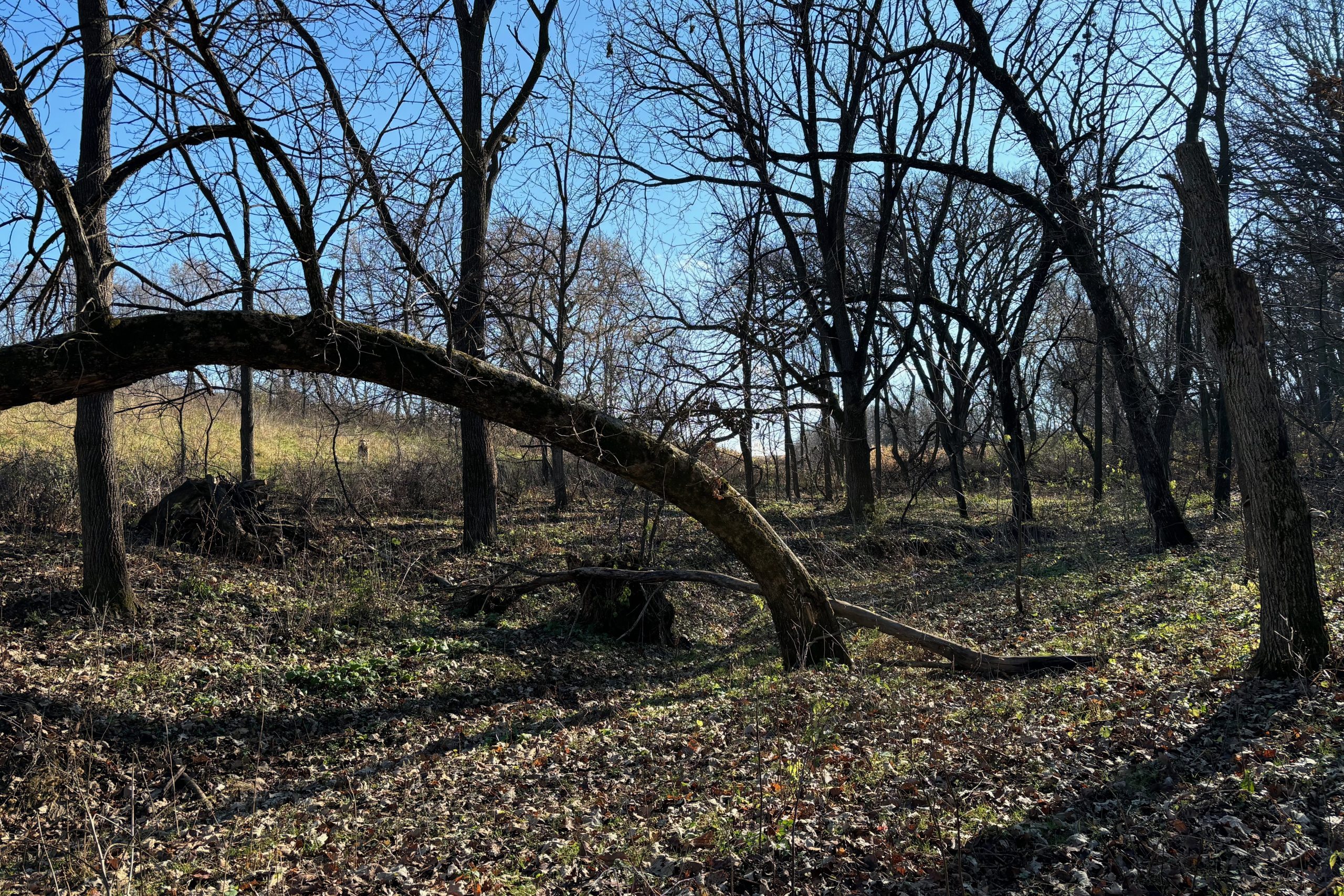
Crunching through fallen leaves on a chilly November day, the little stretch of woods we were wandering around didn’t seem like much to shout about. But to sheep producer Heidi Eger, the woods represented “a match made in heaven” for her sheep and land.
A beginning farmer in southeast Minnesota, Eger is improving the two-acre section of woods to reduce the gully erosion happening through the middle of it. That gully drains into a frog pond, which drains into a trout stream that skirts the land she rents to rotationally graze her sheep. Her land is downstream from a neighbor’s corn field, and that frog pond has turned some “horrible colors” in previous years.
While she couldn’t do anything about land management on the neighboring corn field, Eger realized she could do something to help reduce the sediment and nutrient runoff that was mucking up the pond. That is, she could stabilize the gully through strategic thinning and regrowth management with the help of machinery, manual labor, and her sheep, who just love to eat the brushy regrowth.
Her project is a low-cost, early-intervention edge-of-field solution that should not only protect the stream’s water quality and trout, but also avoid future expenses of a bigger gully repair.
Eger’s experience completing the project highlights two ingredients that seem critical for successful edge-of-field practice implementation: relationships and flexible funding.
To complete her woodland improvement project, Eger received a Good Idea Mini-grant, which awarded funds to seven teams of farmers and farm advisors in the Mississippi River Basin to install edge-of-field practices to improve local water quality and farmland productivity. The mini-grant program also required the teams to produce a video or podcast to share what they did, learned, and gained, with the aim of encouraging other farmers to consider adopting edge-of-field practices.
The Good Idea Mini-grant teams completed their projects by spring of 2025, and the mini-grant administration team interviewed the recipients to glean their insights about what helps edge-of-field practice installation. Here are two themes that stood out.
Relationships Get the Job Done
All mini-grant recipients emphasized the importance of the relationships and resulting teamwork between the farmer and farm advisor, who was often a conservation professional, for not just getting the grant, but also for successful project completion.
Teamwork between a farmer and farm advisor was a by-design requirement of the Good Idea Mini-grant program. This requirement is based on evidence that these relationships are the most consistent indicator of conservation practice adoption, according to findings from the 2021 Conservation Practitioner Poll published by the Soil and Water Conservation Society and Iowa State University.
Indeed, the mini-grant projects demonstrated that, together, the farmer and farm advisor could leverage their different strengths and expertise. In most cases, the farm advisor acted as an intermediary between the farmers and the grant program, enabling the farmer to focus on project implementation, while the farm advisor took care of the paperwork and other administrative matters.
The team approach also enabled the farmer to tap the technical knowledge of the farm advisor. This was the case for Eger, who worked in collaboration with Jim Paulson, a retired University of Minnesota Extension agent who now has his own consulting business. He helped her identify where in the woodland she could focus her efforts to achieve her goals.
“I’m a beginner. This landscape-type project, and especially dealing with water movement, is very new to me,” said Eger.
The grant enabled Eger to hire Paulson and other professionals to tackle thinning the “horrible mess” around the gully, while Eger was able to focus on what she knows best – managing her sheep.
“Everyone achieves more when we can work together,” said Paulson.
Technical and moral support from the farm advisor can also be key to sharing the farmer’s story. For about half of the mini-grant teams, the farm advisors took the lead on coordinating their video production, while the farmer just needed to show up on filming day.
This matters because first-hand accounts from farmers can be powerful motivators to other farmers who are considering implementing conservation practices. For farmers who are not comfortable with the video production process, teaming up makes it easier for them to share their stories.
Flexible Funding Assists Innovation
The seven farm-farm advisor teams installed a variety of practices – from more traditional edge-of-field practices like bioreactors and prairie strips to less conventional approaches, like Eger’s woodland thinning project.
An aspect of the mini-grant program that the teams appreciated was its flexibility, which allowed them to realize visions for their land that perhaps fell outside the bounds of more traditional conservation funding sources, such as federal programs administered by the Natural Resources Conservation Service (NRCS).
Eger’s project likely would not have qualified for larger grants, such as NRCS’ Environmental Quality Incentives Program (EQIP), whether because of its smaller scale or its unconventional approach that involved preserving the woodland, versus installing a fully grassed waterway.
Other teams were able to stack their grant funds with traditional funding sources to install their practices, such as this automated drainage water management system and this bioreactor, both on farms in Illinois.
The program’s flexibility extended to who was eligible for funding. One team included a non-operating landowner who was wanting to do more conservation on his land, but his renter was a newer farmer who had limited capacity to make changes. The landowner had been frustrated by the limited funding options available to him, until he received the mini-grant. It allowed him to install an erosion-preventing field border.
For Eger, the funding did more than just allow her to try something new to improve the landscape. It gave her a profound sense of accomplishment.
“I’m really excited about the fact that I get to use my sheep to partner on a project,” said Eger. She is also excited she could prove to her landowners that they can make a difference on their land with an innovative, low-investment approach.
Header photo: Heidi Eger feeds treats to her two llamas, which guard her sheep. Photo by Jenny Seifert
The Confluence for Watershed Leaders
We are a multi-state community and collaborative of people working for healthy watersheds in the Great Lakes, Greater Mississippi River, and Red River Basins of the U.S. Midwest and Mid-South. The Confluence is where watershed professionals, watershed educators, and engaged farmers and landowners can connect, learn, and increase their success in achieving clean water goals.
Stay in the Know
Subscribe to our email list to get the latest blog posts, opportunities, and more.