

Imagine a future with clean rivers and lakes, resilient and thriving farms, and biodiverse ecosystems. How could we get there? And is it possible to have it all?
This month, a research team from UW–Madison, including the Division of Extension, are publishing four scenarios for the future of the Upper Midwest that demonstrate the scale of change needed to achieve big-picture goals for food and low-carbon energy production, water quality, and ecosystem health.
Six years in the making, the scenarios are part of a project called FEWscapes, which is funded by the National Science Foundation. The project aims to support decision-making for food, energy, water, and ecosystem security in the Upper Mississippi River Basin, a five-state portion of North America’s largest watershed that includes parts of Minnesota, Wisconsin, Iowa, Illinois, and Missouri.
Scenarios are explorations of “what if.” They are hypothetical storylines that play out plausible, contrasting trajectories of current trends and events into the future and incorporate real-world data to reveal possible future outcomes.
For the FEWscapes scenarios, the team developed storylines with input from dozens of agriculture and natural resources practitioners from across the region to envision ways to achieve ambitious goals for food, energy, water quality, and ecosystem health in the Upper Mississippi River Basin to the year 2050.
Jenny Seifert, Watershed Outreach Specialist with UW-Madison Division of Extension Natural Resources Institute, organized a series of virtual workshops with practitioners to determine what goals to shoot for and what might be viable ideas and pathways to achieve them.
“Collaborating with these practitioners ensured the scenarios reflect a diversity of perspectives, not just those of the research team,” says Seifert. “The scenarios wouldn’t be meaningful without a sense of shared ownership by those who are actively shaping the future of the Basin.”
The resulting four FEWscapes scenarios focus specifically on landscape and climate change in the basin. Each scenario has a different driving land-use solution to address nutrient and soil loss. The scenario storylines—four in total— include a suite of other social and political changes, which are based in inklings from today, to help explain how the futures could unfold:
- In Cropland Conservation, the driving land-use solution is ubiquitous use of agricultural conservation practices, such as cover crops and saturated buffers, that blanket 75% of the agricultural land in the basin.
- In America’s Pasture, a grazing movement, spurred by a drastic decline in corn ethanol demand and production, leads to a widespread transformation of cropland to perennial agriculture, resulting in half of all farmland in pasture and agroforestry by 2050.
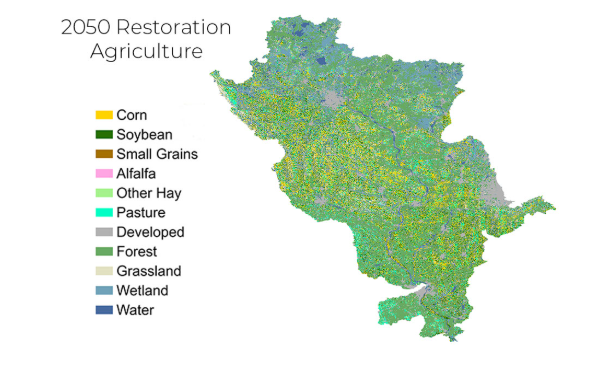
- Restoration Agriculture imagines a future in which half of all farmland in the basin is converted back to the ecosystems they once were—prairies, forests, and wetlands – and their stewardship becomes part of the farming enterprise.
- Hotspots for Transformation is a mix of the other three. Policies target land that is particularly problematic for water quality, and farmers capitalize on a wave of incentives to adopt a medley of conservation practices, ecosystem restoration, and/or perennial agriculture to help cut nutrient loss.
“We recognize that many of the goals voiced by the community are quite lofty and, therefore, require a degree of transformative change to achieve them. Scenario thinking is a way to get out of the trap of focusing only on what appears to be ‘realistic’ in the short-term and having the space to explore bigger changes,” says Eric Booth, a researcher on the project.
The research team used a suite of scientific models that simulate the land-use changes and associated natural processes, such as photosynthesis and the water cycle, that occur in each scenario and produced projected outcomes for future food and biofuel production, water quality, and biodiversity metrics. The models also simulated how the climate—specifically changing precipitation and temperature patterns – could influence future outcomes.
So, can we have it all? Do any of the scenarios reach all of the goals for food and low-carbon energy production, water quality, and ecosystem health?
The short answer is no.
“Previous research has shown that our landscapes may not be able to provide us the desired levels of food production, bioenergy production, water quality, and biodiversity simultaneously,” says Chis Kucharik, the lead investigator on the project. “The FEWscapes scenarios validate that there will be significant tradeoffs between these nature-based benefits, where significant quantities can be achieved for some, but at the sacrifice of others.”
Ultimately, the scenarios are meant to influence the decision-making process, rather than its end point, by highlighting what is necessary and achievable to get a desirable future.
“Our hope is that the scenarios can help practitioners, decision makers, and the next generation of scientists think more holistically about the connections between food, energy, water, and ecosystems and apply that holistic thinking to their work to improve outcomes for nature and human well-being,” notes Seifert.